

Kindergarten slippers requirements: what your little one’s footwear must meet
For kindergarten, choose slippers in the correct size with 1 to 1.5 centimeters of room for growth, a flexible and non-slip sole, breathable material, and easy fastening with hook-and-loop fasteners or elastic. This is also confirmed by physiotherapy recommendations and official kindergarten guidelines. As a manufacturer, it makes slippers that meet the described criteria, breathable and comfortable for the youngest children.
In short:
- To ensure proper foot development, kindergarten slippers should be 1 to 1.5 centimeters longer than the child's longest toe.
- A flexible, non-slip sole and easy fastening with hook-and-loop fasteners or elastic are essential for safe and comfortable use.
- Children's feet should be measured at home with a ruler, adding 1 to 1.5 centimeters, and it is better to measure in the evening, when the foot is slightly swollen.
- The material should be breathable textile or leather that is easy to maintain and prevents unpleasant odors and skin irritation.
- For everyday use, it is recommended to have at least two pairs of slippers, one for indoor spaces and one for outdoor use, with an emphasis on regularly checking for wear.
Table of contents
- Criteria for choosing kindergarten slippers
- How to measure a child’s foot and choose the right size
- Materials and care: what to choose and how to care for slippers
- Safety and hygiene requirements that kindergartens often set
- Expert view: the impact of footwear on children's foot development
- The author's perspective and practical advice for Slovenian parents
- Copa-cop: models suitable for kindergarten
- Sources
- Frequently asked questions
Criteria for choosing kindergarten slippers
Every kindergarten has its own rules, but the basic physical needs of a child's foot are the same everywhere. A toddler's foot grows quickly and the bones are still soft, so footwear must not restrict, squeeze, or provide improper support.
Size is the first criterion. The slipper should be 1 to 1.5 centimeters longer than the longest toe; otherwise, the toes hit the front and gradually become deformed. Shoes that are too small are a more common mistake among toddlers than slippers that are too large, because parents check the size too infrequently.
The sole must be flexible, not stiff. A child's foot bends while walking, and if the sole does not adapt to the movement, walking becomes unnatural. You can recognize a poor sole by trying to bend the slipper with both hands. If it barely moves, it is not suitable for kindergarten, where children run, climb, and jump all day. Slip resistance is equally important, as kindergarten floors, especially in bathrooms, quickly become slippery.
The fastening should be easy for the child to manage independently. Hook-and-loop fasteners or elastic allow children to put on their own slippers, which teachers in groups of more than twenty children genuinely expect. Laces are not practical here because toddlers cannot tie them and they also pose a tripping risk.
Durability is the last, but no less important, criterion. The stitching should be reinforced in the areas where the slipper wears out most, around the toe and heel.
- Size with 1 to 1.5 centimeters of room for growth
- Flexible, non-slip sole
- Easy fastening without laces
- Reinforced stitching in high-wear areas
- Breathable material that wicks away moisture
Expert advice: Check the slippers every six to eight weeks. A child’s foot grows faster during the preschool years than you might think, and sole wear accelerates with daily use in kindergarten.
How to measure a child’s foot and choose the right size
Measuring at home takes less than five minutes, but it determines whether the child will walk comfortably in kindergarten or struggle with their slippers all day.
- Prepare a sheet of paper, a pencil, and a ruler or measuring tape.
- Place the sheet on a hard surface, such as parquet or tiles, never on a carpet.
- Have the child step onto the paper with the weight-bearing foot, as this is slightly longer in most children.
- Trace the outline of the foot with a pencil while the child is standing upright.
- Measure the distance from the heel to the tip of the longest toe.
- Add 1 to 1.5 centimeters to the measured length as room for growth, as parent guides recommend.
Measure preferably in the evening, when the foot is slightly swollen from walking during the day and gives a more accurate measurement. The most common mistake is buying slippers that are already tight when purchased, hoping that they will “stretch”. Textiles and leather adapt to some extent, but never enough to compensate for choosing the wrong size. You can find a detailed procedure with additional examples in the Copa-cop guide to measuring size.
Materials and care: what to choose and how to care for slippers
The material determines how comfortable the child will be in slippers throughout the entire morning in kindergarten, where activity is almost continuous. Cotton textile lets air through well and is usually machine-washable, which is a major advantage for everyday kindergarten use. Soft leather adapts to the shape of the foot and retains warmth well, so it is popular for autumn and winter, although it must be cleaned by hand. Parents often choose wool slippers for first steps or for home, but they are less practical in kindergarten because they take longer to dry. Synthetic materials are inexpensive, but they are less breathable and the foot releases moisture more quickly in them.
When washing, a simple rule applies: wash textile slippers in the washing machine at a lower temperature, while wiping leather slippers with a damp cloth and letting them air-dry away from the radiator. Drying leather too quickly on a heating element causes it to dry out and crack.
- Always have at least two pairs of slippers, one in use and one in reserve.
- Leave the slippers to air out after each day, not in a closed bag.
- Check every week that the inside is dry and odor-free.
- Replace the slippers at the first signs of mold or a worn sole.
Poorly ventilated slippers are one of the more common causes of unpleasant odors and skin irritation in young children, so material breathability is not just a matter of comfort but also of hygiene.
Safety and hygiene requirements that kindergartens often set
Kindergartens generally have an unwritten but clear standard for footwear, which teachers check during the very first week. Sole grip is at the top of the list, as children move across tiles that may be wet while playing and after washing their hands. A slipper that slips on dry parquet will slide even more quickly on a wet tile floor.
Kindergartens often recommend that slippers come with a storage bag and a label bearing the child's name, as they can quickly get mixed up in a group among ten pairs of a similar size. Long straps, dangling decorations and shoelaces are generally discouraged because they pose a risk of tripping or getting caught while climbing on playground equipment. Rigid reinforcements around the ankle restrict natural movement, which is why physiotherapists do not recommend them for everyday kindergarten use.
- Non-slip rubber sole
- Storage bag and a visible name label
- No shoelaces, long straps or rigid supports
- Easy to change if the slipper gets wet during the day
Expert advice: At the introductory meeting, ask the teacher whether the playroom has wet or slippery floors and whether they recommend a second pair of slippers for outdoor use.
Expert view: the impact of footwear on children's foot development
The physiotherapy profession is surprisingly unanimous on this issue. Soft, low-cut slippers with flexible soles allow the foot to bend naturally while walking and strengthen the muscles that will support the child throughout life.
Slippers should be soft, low-cut and should not restrict the foot's natural movement. Breathable materials and non-slip soles are recommended, while hand-me-down slippers that have already molded to another child's foot are not.
A stiff or too-tight slipper acts like a cast because it does not allow the foot to move as it should during a step, and the toes do not receive the load they need for the arch to develop properly. Although official information about kindergarten enrollment and operation does not prescribe a specific footwear model, kindergarten teachers rely on precisely these kinds of expert recommendations in their daily instructions to parents.
The author's perspective and practical advice for Slovenian parents
As a first purchase, I would always choose two pairs at once: one textile pair for indoor use and one with a more durable sole for playing in the yard. A spare pair in the kindergarten locker can prevent many a morning drama when the slippers are still wet from washing overnight.
When buying footwear online for a child whose size you do not yet know reliably, the option to exchange or return the slippers is actually more important than the price. A child's foot can change between delivery and the first time they put them on more quickly than you expect.
— Črt
Copa-cop: models suitable for kindergarten
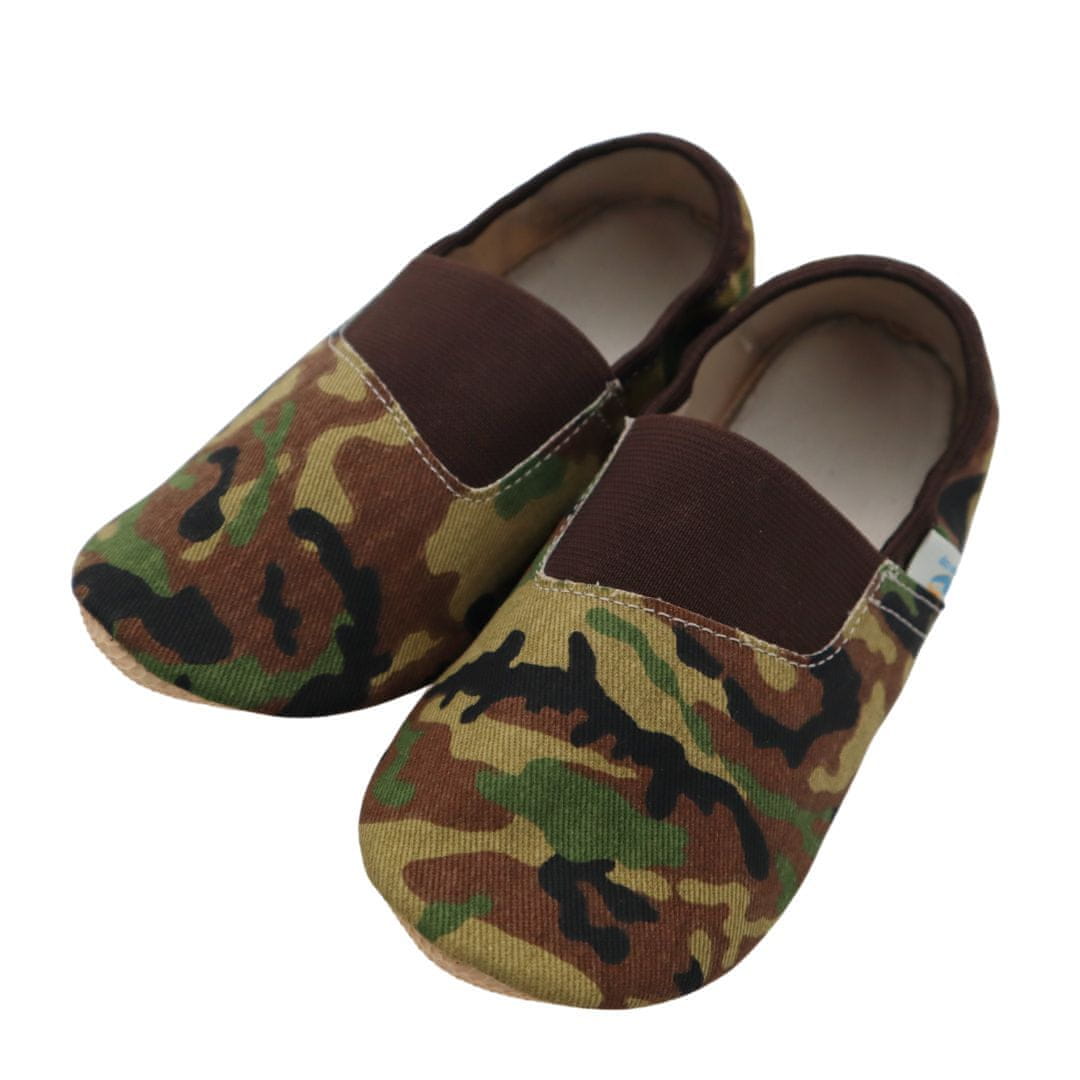
Among the products that meet nearly all the criteria in this guide, the standout is the Camo boys' textile slipper. It is made of breathable textile, has a flexible sole and a hook-and-loop fastening that children can master after just a few days of practice.
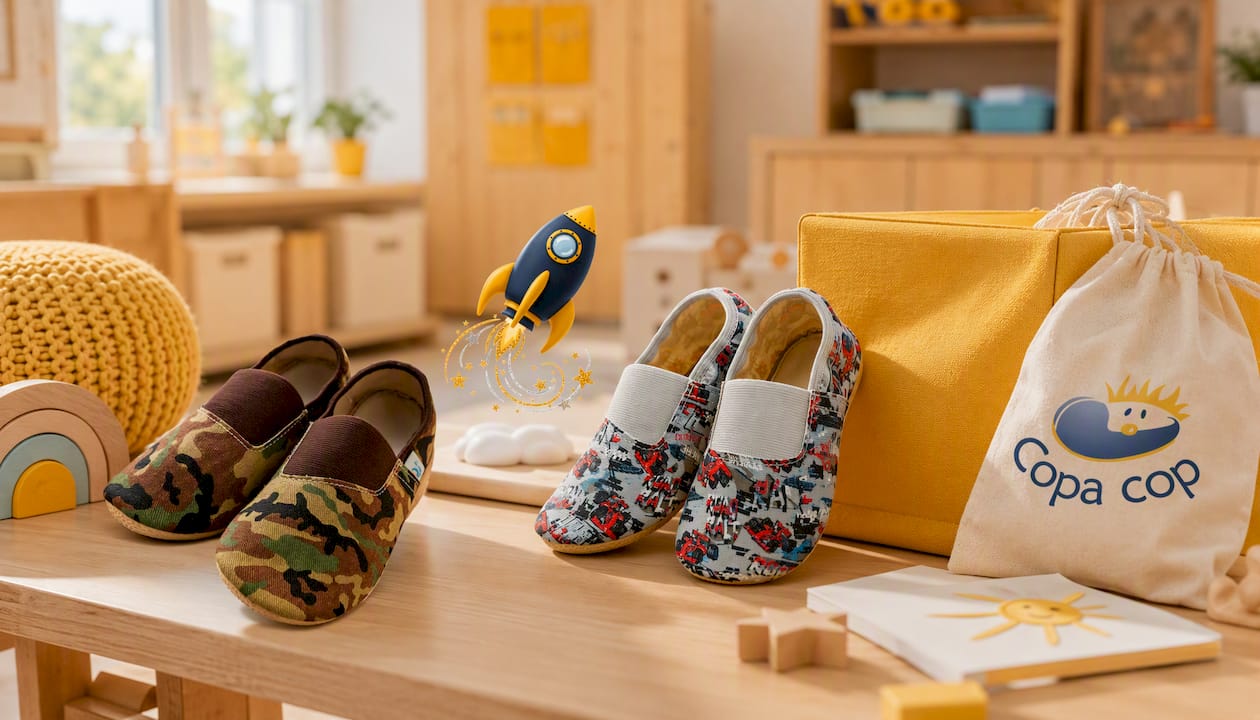
The Formula boys' textile slippers are similarly designed and, in addition to comfort, offer another advantage that is rare among other Slovenian retailers: the option to exchange or return them if the size turns out to be wrong. For parents arranging their purchase just before the first day of kindergarten, priority order processing is also available, allowing the package to arrive faster than with a standard order. The slippers are handmade from natural materials, which means less skin irritation and better breathability for textile and leather footwear used every day in kindergarten. If you are looking for a wider selection, browse the full range of children's slippers or school slippers for older children who are moving on from kindergarten to school.
Sources
Frequently asked questions
What size allowance is suitable for growth?
The recommended allowance is 1 to 1.5 centimeters from the longest toe to the tip of the slipper, as parent guides advise. A smaller allowance restricts toe movement, while a larger one causes tripping.
How often should I buy new slippers for kindergarten?
A preschooler's foot grows quickly, so check the size every six to eight weeks. Replace the slippers as soon as the sole feels hard to the touch or the toes reach the tip.
Do kindergarten slippers need to be machine washable?
It is not essential, but highly recommended, as footwear gets dirty and damp quickly in kindergarten. Textile models, such as the Camo boys' textile slippers by Copa-cop, are machine washable, while leather ones must be cleaned by hand.
How many pairs of slippers should a child have in kindergarten?
It is recommended to have several pairs of slippers, one for everyday use and at least one spare pair in the cubby. This is also confirmed by practical kindergarten preparation checklists.
Are hand-me-down slippers suitable for kindergarten?
Physiotherapists do not recommend hand-me-down slippers because the sole has already taken the shape of the previous child's foot. For healthy foot development, it is better to buy a new pair suited to the child's size.


