

For parents: vegan slippers that bring comfort, safety, and durability
Vegan slippers offer three concrete advantages: they are made without animal materials, are generally easier to clean, and cost about the same as leather models at the same quality level. But “vegan” is not synonymous with “sustainable” or “healthy for feet” - the material, certification, and cut are what matter. Copa-cop therefore offers textile barefoot models that combine all three advantages without compromise.
In short:
- When choosing vegan slippers, it is important to consider that there are four material groups that differ significantly in durability, breathability, and renewability.
- Materials such as recycled textiles and cork are more environmentally friendly, while microfiber offers greater durability but lower renewability.
- The V-Mark certification makes it possible to verify whether a product truly contains no animal ingredients and eliminates misleading claims.
- For long-term use and the health of a child's feet, fit, sole flexibility, and the appropriate material for the intended use are important.
- If the environment is the primary concern, choosing natural fibers is recommended; otherwise, high-quality microfiber remains a legitimate choice for affordable and durable footwear.
Table of contents
- Materials used in vegan slippers and their advantages
- Sustainability: when are vegan slippers really better for the environment?
- Certifications and claims: how to verify the vegan status and ethics of slippers
- How to choose vegan slippers: a shopping checklist
- Caring for vegan slippers by material
- Why Copa-cop understands what a truly vegan slipper means
- Which Copa-cop models to choose based on the child's needs
- Sources
Materials used in vegan slippers and their advantages
When we say “vegan slippers,” we are actually talking about four material families that differ from one another more than you might expect.
Microfibers based on polyurethane (PU) or PVC are the most common replacement for leather. Modern, high-quality microfibers achieve comparable tensile strength and tear resistance to natural leather, meaning that slippers last for years of wear without cracking. The drawback is the petroleum-based production process and slower degradation after their useful life.
Recycled textiles and cotton are at the opposite end of the spectrum. Slovenian examples on the market, such as slippers made from 84% recycled cotton, show that it is possible to make completely vegan slippers without synthetic leather. Textiles are also breathable, which is a major advantage for children's feet, which quickly become sweaty during play.

Cork and plant-based alternatives, such as Piñatex made from pineapple fibers, are considered the most renewable group. They grow quickly, require less chemical processing, and put less strain on the environment at the end of their life cycle.
For indoor school use, textile and cotton models perform best because they are breathable and dry quickly. For outdoor wear and rain, microfiber or treated textiles with a protective layer are more suitable.
- Microfiber (PU/PVC): durable, but less renewable.
- Recycled textiles and cotton: breathable, suitable for school and home.
- Cork and Piñatex: quickly renewable, but less widely available on the market.
- Combined models with protection: suitable for outdoor play.
Sustainability: when are vegan slippers really better for the environment?
The absence of animal-based materials does not automatically mean a smaller environmental footprint. Market analyses show that demand for synthetic leather substitutes is growing rapidly, while data on their actual environmental impact is often incomplete. PU and PVC consume fossil fuels during production and decompose slowly in nature.
Expert advice: If sustainability is your main concern, look for recycled textiles, cork, or plant-based materials such as Piñatex, rather than just the label “leather-free.”
When this information is unavailable, it is often just a marketing label reading “vegan,” with no proven environmental advantage.
The recommendation is simple: if the environment is a priority, choose textiles and natural fibers over synthetic leather. If price and durability are the priorities, quality microfiber is a perfectly legitimate choice, but do not expect it to be “green” in the true sense of the word.

Certifications and claims: how to verify the vegan status and ethics of slippers
A certification such as V-Mark confirms that the product contains no animal-derived materials and allows buyers to verify claims rather than simply relying on the seller’s words. This is the essential difference between a serious certification and merely having the word “vegan” written on the packaging.
A news report about vegan wooden sports slippers warns that we must also check the adhesives and other components, not just the upper material. This is where animal derivatives are most often hidden, which the upper layer does not reveal.
Before you buy, check the following:
- Is a recognized certification listed on the product or page, rather than just the word “vegan”?
- Does the product description also mention the adhesives, sole, and stitching?
- Does the seller give a specific answer when asked about the composition, rather than just a general one?
How to choose vegan slippers: a shopping checklist
Choosing the right slippers is a combination of comfort, materials, and sound judgment about price. Here is a sequence of steps that simplifies the decision.
- Check the fit and toe room. The toe box should be wide enough for the toes to spread naturally, which is a key criterion for children's slippers for healthy foot development.
- Test the sole's flexibility. The sole should bend at the toes, not in the middle, otherwise it restricts the foot's natural movement.
- Choose the material according to its purpose. Textile is sufficient for school and home; for long walks or outdoor play, choose a more durable material with protection instead.
- Check the label and certification. Look for a mark such as V-Mark, or at least a precise description of the composition.
- Check the return policy. A child's foot changes faster than you expect, so the option to exchange is an important safeguard.
- Compare the price with the expected lifespan. A cheaper slipper that falls apart in three months ultimately costs more than a higher-quality model.
Caring for vegan slippers by material
Proper care extends the life of slippers by months, sometimes even an entire additional season.
Textile and cotton slippers can usually be washed by hand in lukewarm water with mild soap, but never in a washing machine at a high temperature, as the fibers will lose their shape. Wipe microfiber with a damp cloth and leave it to air-dry away from radiators or direct sunlight. Clean cork or rubber soles with a soft brush and always stuff them with paper after washing to help them keep their shape.
- Never dry them on a radiator or in a tumble dryer.
- Do not use harsh cleaners or bleach.
- Stuff the slippers with paper after each wash to help them keep their shape.
- Regularly check the seams and sole for signs of wear.
Expert advice: Dry the slippers separately, upside down, so water drains from the seams instead of collecting in the toe box.
For more detailed instructions on daily care, see the guide to caring for slippers at home.
Why Copa-cop understands what a truly vegan slipper means
At Copa-cop, we make slippers in Slovenia and test every model with one thought in mind: how a child’s foot feels, not just how the slippers look on the shelf. Our breathable materials for children's slippers are chosen so the foot can breathe and the slippers can be put on easily at the kindergarten door.
Because we know that a child's foot can change overnight, we offer exchanges or returns and free shipping on orders over €50. This is not a marketing extra, but our way of relieving parents' worries if the slipper does not fit properly.
Whether you choose a textile or leather model, the child's foot should decide, not the trend. We are here to offer you an honest selection of both.
— Črt
Which Copa-cop models to choose based on the child's needs
Among the textile barefoot models, Barefoot Hearts and Barefoot Panda stand out. Both are made of breathable textile suitable for school and home, where easy cleaning and a soft sole may be more important than protection from the weather.
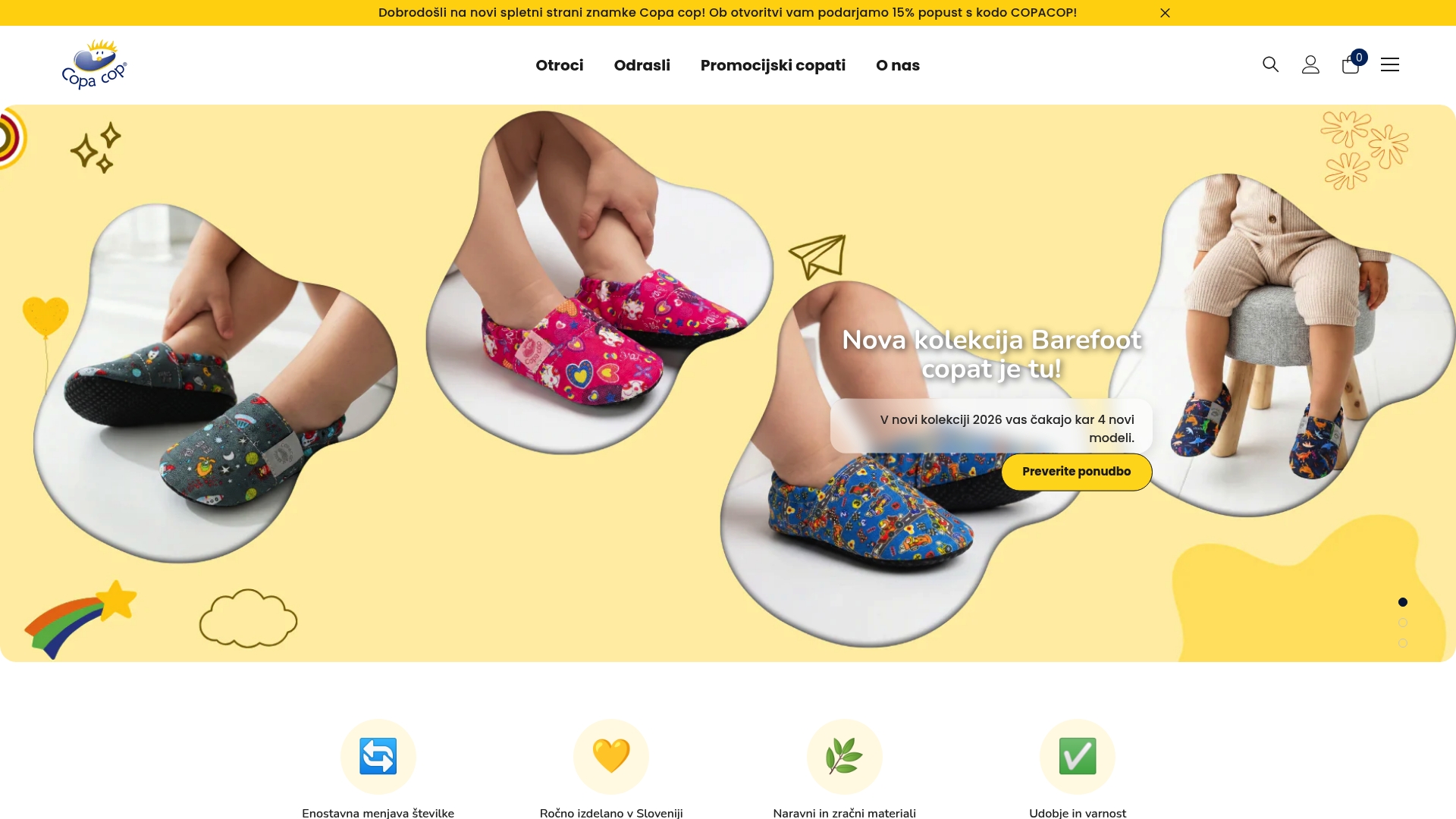
For more active children who like rolling around on the playground floor, Barefoot - Trucks and Barefoot - Cats with protection are made to withstand more rubbing while maintaining a flexible, nature-friendly sole.
For boys who need a more formal school slipper, we offer leather Boy’s Uni models in three versions: Football, Gaming and Handball. These versions are for parents looking for the durability of leather in a child-appropriate, relaxed design. As with choosing suitable transitional jackets for boys, it is equally important for footwear that the material follows the child's movement, not the other way around.
If you are choosing for the first time, take a look at the full slipper selection on the homepage and take advantage of the exchange option if the fit does not turn out to be right. Returns and exchanges are always possible with us, and shipping is free for orders over €50.


