

First grade: slipper requirements parents look for before school
For a first-grader, you need slippers with a non-slip sole, a stable heel, and a proper fit in both length and width. School lists in Slovenia usually state this explicitly, since hallways and stairs require safe footwear. Measure your child's foot while standing, choose slippers with a little room for the toes, and avoid backless slip-ons.
In brief:
- The most important features of school slippers are a non-slip sole with a pronounced tread, a reinforced heel, and breathable materials.
- Children's feet should be measured while standing. The slippers should leave a little room for the toes, but shouldn't be too big.
- Buy the slippers at least a week before school starts so your child can try them on properly and learn to put them on independently.
- When choosing slippers, look for a closed heel, with an adjustable elastic or hook-and-loop strap for a better fit.
- Clean off dirt and the soles regularly. Textile slippers can be washed at up to 30 degrees, while leather ones should be wiped with a damp cloth.
Table of contents
- What schools in Slovenia usually require and why
- Which features really matter in slippers
- How to measure your child’s foot for the right size
- Care, washing and storage throughout the school year
- First day of school checklist: what to prepare in advance
- Which Copa-cop models are suitable for first grade
- What parents most often get wrong when choosing slippers
- Sources
What schools in Slovenia usually require and why
When you open the school supplies list for first grade, you’ll almost certainly come across the same phrase: “school slippers with non-slip soles.” This isn’t just wording that schools came up with on their own. It’s a recurring standard found on the joint list of supplies for first grade for the 2026/2027 school year, as well as on other lists across Slovenia.
The reason is simple and practical. First-graders run through hallways, slide on stairs, and race around during breaks on linoleum, which gets slippery after rain or mopping. A slipper without adequate grip isn’t just a safety detail - it’s a real fall hazard.
In addition to a non-slip sole, there’s almost always another item on the lists that parents often underestimate:
- slipper bag – for storing in the cloakroom and carrying home
- non-slip sole – an explicitly stated requirement on most lists,
- non-slip sole – an explicitly stated requirement on most lists,
- spare pair of socks – recommended, but not always required,
- comfortable, lightweight footwear – suitable for wearing for long periods each day.
It is worth taking the slipper bag seriously, as it is also listed as a separate item, apart from the slippers themselves, on the school supplies list. Some lists also clearly distinguish between what is paid for by the Ministry of Education (workbooks) and what parents need to provide. Slippers always fall into the latter category.
Which features really matter in slippers
A non-slip sole is the first and most important feature, but it does not count for much on its own if it is not properly designed. A good sole has a pronounced tread (small ridges or a wavy pattern) to improve grip on smooth floors, and is made of rubber that does not harden quickly. The slipper should also have a reinforced heel that keeps the foot in place and prevents it from sliding forward while walking.
For materials, you basically have two options: textile or leather, and each has its advantages.
- Textile slippers are comfortable, lightweight, and breathable, which is a major advantage when worn all day at school.
- Leather slippers are more durable, hold their shape better throughout the year, and withstand more intensive use during play.
Construction is where mistakes most often happen when buying in a hurry. Look for elastic or a hook-and-loop strap that allows adjustment, since children’s feet can change by as much as half a size over the year. A closed heel without an opening is essential, while flip-flops and slippers without a heel are not recommended. The professional document about slippers at school, prepared by Dr. Suzana Škorjanc Antolič, warns that such footwear can affect the development of children’s feet, ankles and even spine over time while they are still growing.
The sole should flex at the toes, but not in the middle of the foot. If the slipper bends in the middle like a paper bag, it does not provide enough support when pushing off.
Expert tip: Bend the slipper in your hands. If it bends exactly where the toes would bend, the sole is correctly designed. If it twists in the middle or is completely rigid, it is not suitable for everyday use at school.
How to measure your child’s foot for the right size
The wrong size is the most common mistake when buying school slippers, and most often parents think, “better a little bigger, so they’ll last longer.” But slippers that are too big actually increase the risk of falls because the foot slides around inside them.
- Have your child stand on firm paper or cardboard, because the foot spreads and lengthens under body weight compared with a measurement taken while sitting.
- Trace the outline of the foot with a pencil, keeping the pencil perpendicular to the paper, not tilted.
- Measure the distance from the heel to the longest toe, usually the big toe.
- Allow about a small amount of extra room for the toes, no more, as this is a safety margin, not room for future growth.
- When shopping in-store, have your child wear the socks they will wear at school and check how they walk after a few steps; convenient styles are also available in the Back to School – Refurbished Amsterdam sale.
- Press the area in front of the toes while your child is standing to check the actual amount of room without guessing.
Some manufacturers, including Copa-cop, recommend buying one size larger to allow for children's rapidly growing feet, but with one clear condition: the slipper must not be so large that the foot slides back and forth inside it. If the heel lifts out of the slipper when walking, it is too big, regardless of how well it fits lengthwise.
Care, washing and storage throughout the school year
Slippers can take a lot of wear throughout the school year, but only if you care for them regularly. Textile models, often made of cotton, can be washed at temperatures up to 30 degrees, which helps preserve the material and colors. Always air-dry them away from radiators, as high temperatures can damage the sole adhesive.
Leather slippers cannot withstand machine washing. Wipe off dirt with a damp cloth, and occasionally apply leather balm to keep the leather from becoming stiff and cracked.
- Clean the soles regularly with a brush, as built-up dirt reduces their grip on the floor.
- Dry the slippers completely after each wash before putting them in the bag.
- Keep the slipper bag in a dry part of the backpack, not in an unventilated plastic cover.
- Check the seams and strap once a week, as an early repair extends the life of the slippers.
Regularly cleaning the soles actually restores their grip, as dust and dirt on the rubber reduce slip resistance more than you might expect.
First day of school checklist: what to prepare in advance
A little preparation before September 1 saves a lot of morning panic. The checklist below covers what parents most often forget, not just the slippers themselves.
- Buy the slippers at least a week before school starts so your child can try them on at home on hard floors.
- Get a slipper bag and label it straight away with your child's name and class.
- Add a spare pair of socks to the bag, as first-graders often get wet or dirty.
- Use a permanent marker or a sewn-in label to mark the slipper itself, not just the bag.
- At home, ask your child a few times to put on and take off the slippers by themselves, as they’ll be doing this independently at school.
- Check that the slipper fits snugly at the heel before taking it to the cloakroom for the first time.
This process works best if you spread it over two or three days, rather than leaving it until the last evening before September 1.
Which Copa-cop models are suitable for first grade
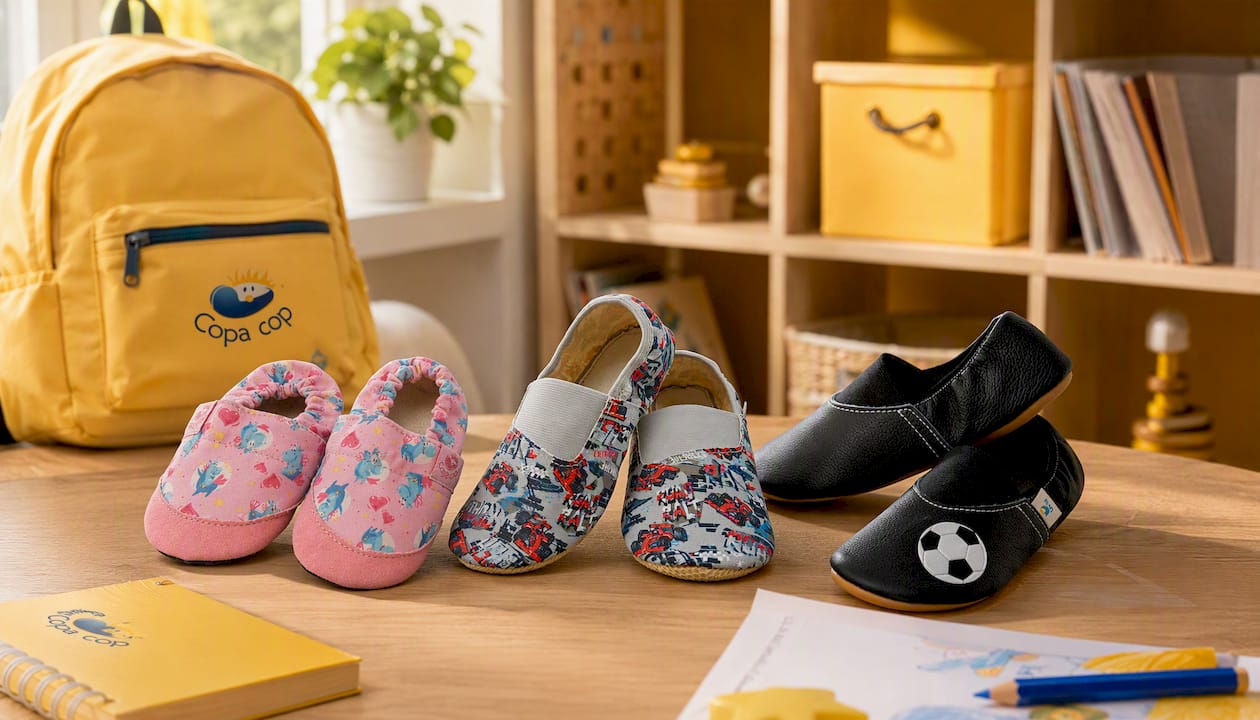
Among the slippers we most often recommend at Copa-cop for first graders, three models stand out, each with a different purpose.
Children’s protective Barefoot textile slippers - Pink Unicorn are designed for girls who will wear slippers all day in the classroom. The Barefoot sole design preserves the foot’s natural movement, while the protection at the front prevents the toe from wearing out quickly due to bumps against chairs and desks.
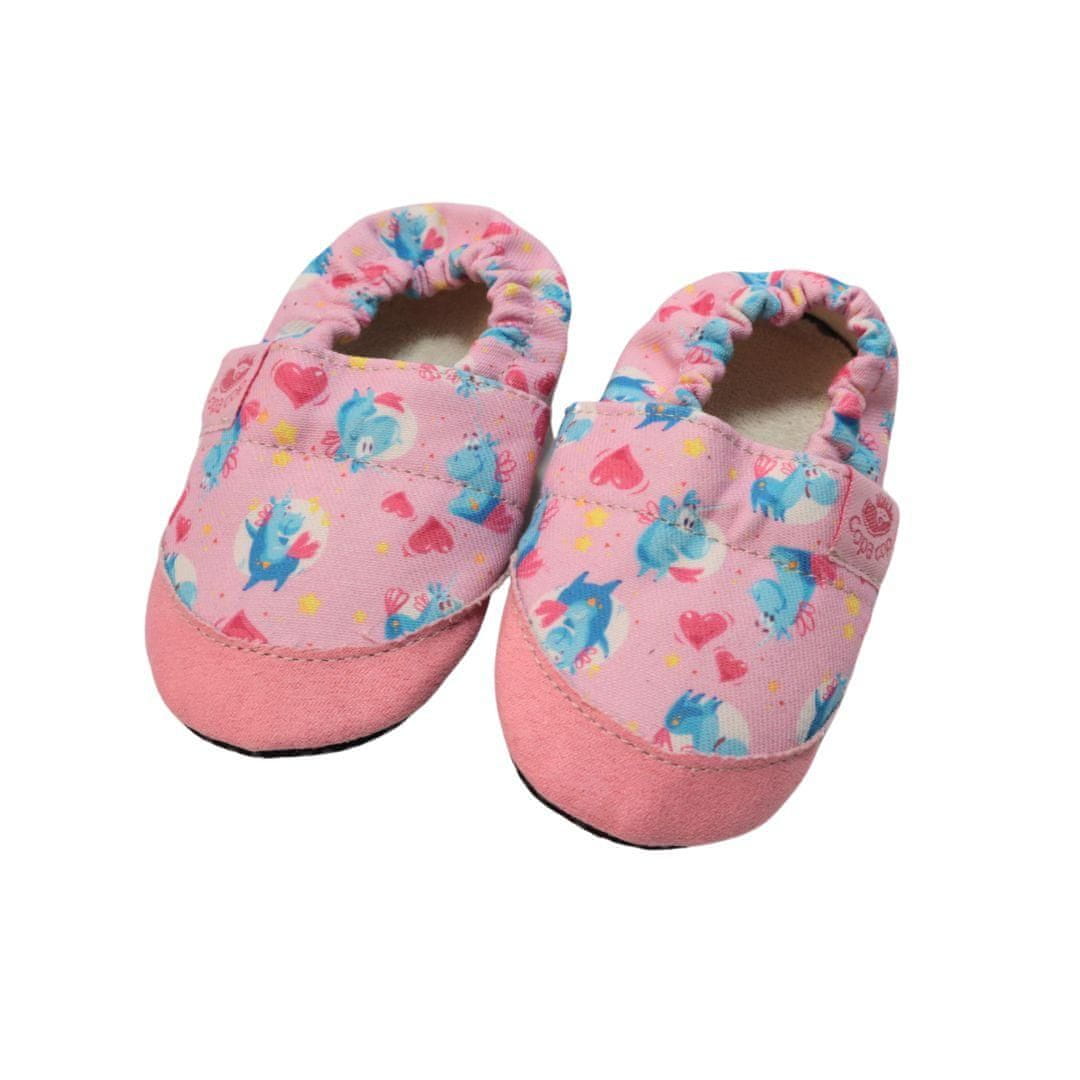
Formula textile slippers for boys are lightweight and breathable, which is key if your first grader will spend six hours of lessons in them. The textile upper lets the foot breathe, while the hook-and-loop strap provides adjustability as the foot changes slightly throughout the year.
For parents looking for a more durable alternative for more intensive use, Boy’s Uni Soccer leather slippers are a great choice. Leather withstands daily rubbing against chair legs and gym floors better, while also retaining its shape longer than textile.
When ordering, we recommend first measuring your child’s foot using the steps described above and choosing a size based on its actual length, not the child’s age. If the size turns out to be wrong, check the exchange or return options, as different delivery terms may apply. For a detailed overview of the requirements and additional tips, see our school slippers guide before adding the product to your cart.
What parents most often get wrong when choosing slippers
When working with parents of first graders, I notice one recurring mistake: they buy slippers that look comfortable in the store, but aren’t functional in the school hallway. The child stands on a soft rug by the shelf, the slippers seem soft and cozy, but at home on the parquet or at school on the linoleum, it turns out that the soles slide like crazy.
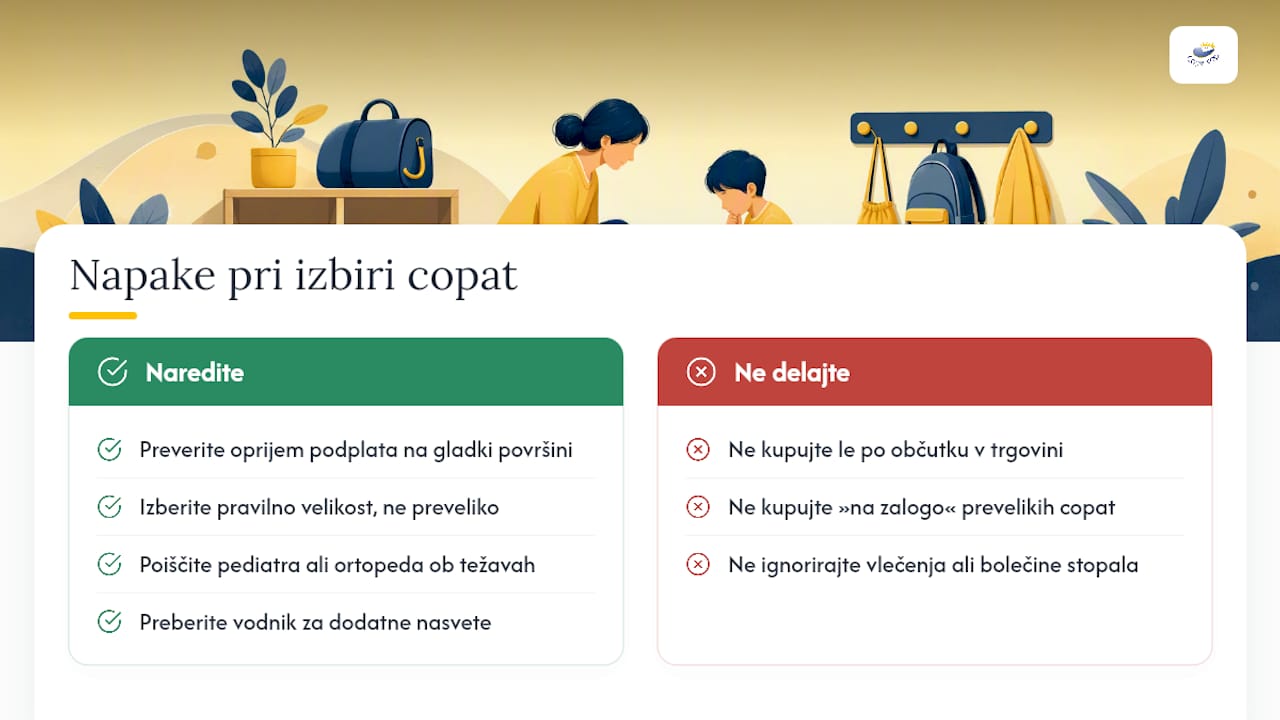
Another common pitfall is buying shoes "for later"—that is, much too large, in the hope that they will last two years. This almost always backfires, as a child walks unsteadily in oversized shoes and is more likely to fall, which is precisely the opposite of what non-slip soles are meant to achieve.
If you notice that your child drags a foot while walking, often trips, or complains of foot pain even after a few weeks of getting used to the shoes, this is not a sign that they will "get used to it." In that case, seek the advice of a pediatrician or orthopedist, as a minor anatomical difference may require a different sole shape than standard footwear offers. For more guidance on healthy foot development, parents can also see our guide to shoe bags, which includes other practical tips for the first weeks of school.
— Črt
Sources
Buying school shoes is a small decision, but it rests on two solid foundations: official school requirements and expert knowledge of children's feet. Both point in the same direction.
School lists consistently require non-slip soles, as confirmed by documents from primary schools across Slovenia. This is not a recommendation, but a requirement that teachers actually check during the initial inspection of students' belongings.
On the other hand, there is expert opinion explaining why this requirement makes sense beyond school hallways:
Flip-flops and shoes without a heel or adequate support can have long-term effects on the development of the feet, ankles, and spine in children who are still growing.
This warning from Dr. Suzana Škorjanc Antolič in her expert document on shoes at school is why choosing shoes is not just a matter of color or pattern. These two guiding principles are taken into account when developing the shoes, which is why the models feature a reinforced heel, a flexible sole, and breathable materials. This does not mean that every shoe is a miracle solution, but it does mean that the choice is not left to chance.
For an in-depth explanation of how these criteria translate into a specific product, see our guide to healthy foot development, where we explain why sole shape is more than just an aesthetic choice.
- Shared Supplies List for Grade 1 (2026/2027) - Sveta Ana
- School Shoes — Expert Document (Dr. Suzana Škorjanc Antolič)
- School Supplies List for Grade 1 (2026/2027) - Primary School


