

Footwear exchange rules: what you need to know before exchanging
In Slovenia, three basic rules apply to footwear exchanges: the deadline set by the retailer (most commonly between 14 and 31 days), an undamaged product in its original packaging, and proof of purchase. Voluntary exchanges for personal reasons, such as slippers being too small, are at the retailer's discretion, while a complaint due to a defect is a legally protected right. The first step after a purchase that does not work out is to check the retailer's general terms and conditions, where the deadline is stated clearly in writing.
In brief:
- Exchanging footwear depends on the deadlines set by each retailer, most commonly between 14 and 31 days, and is not legally required.
- Before exchanging, an unused product must be returned in its original packaging, with the receipt, and without signs of wear or damage.
- For complaints due to a product defect, you have the right to request a repair, replacement, price reduction, or refund, regardless of the retailer's policies.
- To test footwear wear, use foam compression and torsional twisting, as visual signs are not always reliable.
- Exceptions such as custom-made products, hygiene items, or products showing signs of use usually exclude the possibility of exchange.
Table of contents
- Standard retail rules for exchanging footwear
- Consumer legal rights: claims versus voluntary exchanges
- Exceptions: when exchanging footwear is usually not possible
- Steps for exchanging footwear: the procedure in stores and for online orders
- Practical tests and tips for assessing footwear wear
- The author's perspective and how Copa cop handles exchanges
- What’s worth knowing before you go to the store
- Copa cop makes exchanging footwear simple, not exceptional
- Sources
Standard retail rules for exchanging footwear
Each retailer sets its own rules, so there is no universal exchange deadline in Slovenia. The Consumer Protection Act does not require exchanges for personal reasons, but leaves this to the retailer, which uses it to compete for customers' trust. This means that you should always check the general terms and conditions of the specific store where you shop.
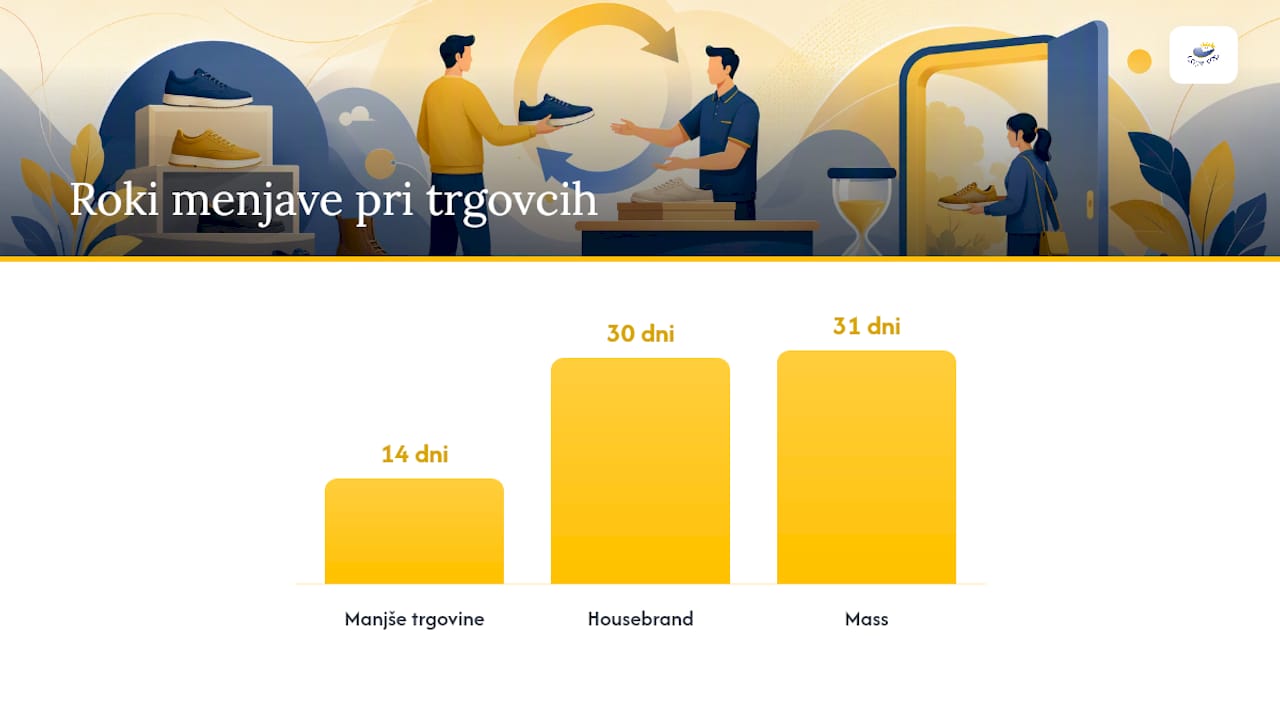
Deadlines vary considerably between retailers. Housebrand, for example, publicly states a 30-day period for returns and exchanges, while Mass states in its terms and conditions that exchanges are possible within 31 days upon presentation of the receipt. Some retailers allow only 14 days, which is most common among smaller specialized stores. The difference between 14 and 31 days is not insignificant if you bought the slippers just before the holidays and your child does not try them on until you get home.
What exactly to check before heading to the store:
- Exchange deadline – look for it in the general terms and conditions, usually at the bottom of the retailer's website or on the back of the receipt.
- Condition of the product – the slippers must be unworn, with no signs of use on the sole and no odor.
- Original packaging – the box, hang tags, and any additional insoles must be returned together with the footwear.
- Proof of purchase – an invoice or proof of payment; for online purchases, an electronic order confirmation is often sufficient.
- Refund method – check whether the retailer will refund your money, issue a credit note, or offer only an exchange for another product.
The phrase “undamaged” in the terms and conditions means more than just a visual inspection. The retailer checks whether the sole is clean, whether the laces are untouched, and whether the inside of the shoe shows signs of wear, such as foot impressions or crumpled padding. Original tags are crucial here, as without them it is difficult for the retailer to prove that the product was only tried on at your home and not used on a daily basis. This is why most retailers recommend trying children's footwear on a carpet or on textile flooring at home, rather than on asphalt or at a playground.
A retailer has the right to refuse an exchange if it finds signs of wear, a damaged sole, or missing packaging. In such a case, it is not obliged to offer an alternative solution, which means that the footwear remains yours. As for return costs for an in-store purchase, there are generally no additional costs unless the retailer expressly provides otherwise. For online purchases, the return postage cost is often passed on to the customer, except when the product is defective or the retailer offers free returns as part of its service.
Consumer legal rights: claims versus voluntary exchanges
Exchanging an item for personal reasons and making a claim due to a defect are two completely different things, although customers often confuse them. A voluntary exchange, for example because a slipper is too small or the color is not to your liking, depends solely on the retailer's goodwill and general terms and conditions. A claim due to a material defect, however, is a legally protected right governed by the Consumer Protection Act and cannot be rejected by the retailer merely on the basis of its own rules.
A material defect means that the product does not have the qualities it should have for its intended purpose, such as a cracked sole after two weeks of normal use or a seam that has come apart without an external cause. In such a case, you have the right to request a repair, replacement with an identical or similar product, a price reduction, or a full refund. The retailer cannot redirect your claim to the manufacturer, as the seller is directly responsible.
Expert information: when asserting a material defect, it is crucial to notify the retailer as soon as possible after noticing the defect, as a late report may weaken your position when proving that it was a product defect rather than wear and tear from use.
The practical procedure for filing a footwear complaint looks like this; for more information, you can also file a complaint with anpc gov:
- Photograph the defect as soon as you notice it, with a clear shot of the damaged area and the entire product.
- Keep the receipt or proof of purchase, preferably in electronic form as well.
- Take the footwear to the store where you bought it and request a written report confirming receipt of the complaint.
- Clearly state which remedy you want: repair, replacement, a price reduction, or a refund.
- Request a copy of the report or confirmation that your complaint has been submitted for your records.
A report filed in the store is not merely a formality. If the dispute escalates, for example to the market inspectorate or a consumer organization, a written record is the only thing you can rely on. Retailers, as evidenced by Housebrand's practice, recommend a brief written note on the receipt or a separate report for every complaint or exchange, which makes it easier for the customer to pursue any further claims. Photos should be taken in good lighting, with a size reference if the damage is small, such as a crack in a seam or a sole that is coming away.
The difference between these two options is therefore simple: if the shoe is simply the wrong size or color, you depend on the retailer's goodwill and its exchange policy. If the shoe is actually damaged or defective due to a manufacturing fault, you have a legal right to a remedy, regardless of what the retailer's terms and conditions say.
Exceptions: when exchanging footwear is usually not possible
Some products are inherently excluded from exchanges, regardless of how customer-friendly the retailer's policy is. Knowing these exceptions saves you time and disappointment, as you will know what you can realistically expect.
Personalized or made-to-measure slippers are a classic example. If the footwear was made according to your specifications, for example with an embroidered name or a selected color combination, the seller will generally not allow an exchange, as such a product cannot simply be returned to sale. This also applies to personalized leather slippers with embroidery, where each item is made for a specific child.
The exceptions generally include:
- Made-to-measure or personalized products - items made specifically for you cannot be returned to regular sale.
- Hygiene products with opened packaging - this applies mainly to socks, insoles, and similar footwear accessories, where opening the packaging is a sign of direct use, as also noted by MOSKIinPOL.
- Products with obvious signs of use - a scratched sole, dirt on the inside, or an odor is sufficient reason to refuse an exchange.
- Promotional and sale items - special caution is required here, as the rules on seasonal sales of textiles and footwear regulate when and how a seller may conduct a sale, which indirectly also affects the exchange conditions for such products.
For promotional items, it is often stated that an exchange is possible only for another product from the same promotion, not for a refund. This is not necessarily unfair, as the price is reduced, but it is a good idea to check this before purchasing, not afterward. If you are buying footwear for a child who is growing quickly and are considering a promotional offer, ask the seller for a clear answer before paying.
Steps for exchanging footwear: the procedure in stores and for online orders
The exchange procedure depends on where you purchased the footwear, as the rules for physical stores and online orders differ mainly in terms of who covers the return cost and how quickly you receive a response.
When visiting a physical store, follow this sequence:
- Prepare proof of purchase - bring the receipt or proof of payment, and preferably the original packaging as well.
- Check the condition of the footwear at home - slippers should be clean, with no signs of wear on the soles, and have all labels attached.
- Visit the store within the specified period - make sure you are within the deadline set out in the general terms and conditions.
- Request an in-store inspection - the seller will inspect the footwear and determine whether it meets the requirements for an exchange.
- Request written confirmation – a report or note on the receipt can be useful if a disagreement arises later.
For an online order, the procedure is similar, but with the additional step of notifying the seller before shipping:
- Notify the seller – under the terms of some online stores, such as MOSKIinPOL, you have approximately 15 days from receipt of the package to notify them about the exchange.
- Wait for instructions – the seller will tell you whether to send the return to their address or through an agreed carrier.
- Send the footwear back – in the original packaging, with all labels and proof of purchase.
- Check who covers the shipping costs – this depends on the seller's terms; some cover them themselves, while others charge the customer.
- Track the status of the return – a good seller will notify you when they receive the package and when the exchange or refund has been completed.
Expert advice: when writing to the seller, be specific. A short message, for example “Order number 12345, size 32 sneakers, please exchange them for size 33, as the current ones are too small. I have attached the receipt and a photo of the label”, saves the seller time when processing the request and helps you receive a faster response.
The advantage of buying in person is that you can check the condition of the footwear together with the seller on site, reducing the possibility of disagreement about whether the signs indicate wear. With an online purchase, it is crucial not to miss the deadline for notifying the seller about an exchange, as after it expires, the seller is not obliged to honor the request.
Practical tests and tips for assessing footwear wear
Before deciding to replace an item because of a suspected defect, it is worth checking whether it is genuinely a manufacturing defect or simply normal wear. Simple mechanical tests that you can perform at home in a few minutes can help.
The foam compression test is one of the most reliable indicators of cushioning wear. Use your fingers to compress the midsole in the most heavily loaded area, usually under the heel or toes. If the foam does not quickly return to its original shape or is noticeably softer than in a new product, the cushioning has lost its function. Another useful test is torsional twisting, in which you hold the front and back of the sole with your hands and gently twist them in opposite directions. A sole that twists too easily or unevenly on one side indicates structural wear.
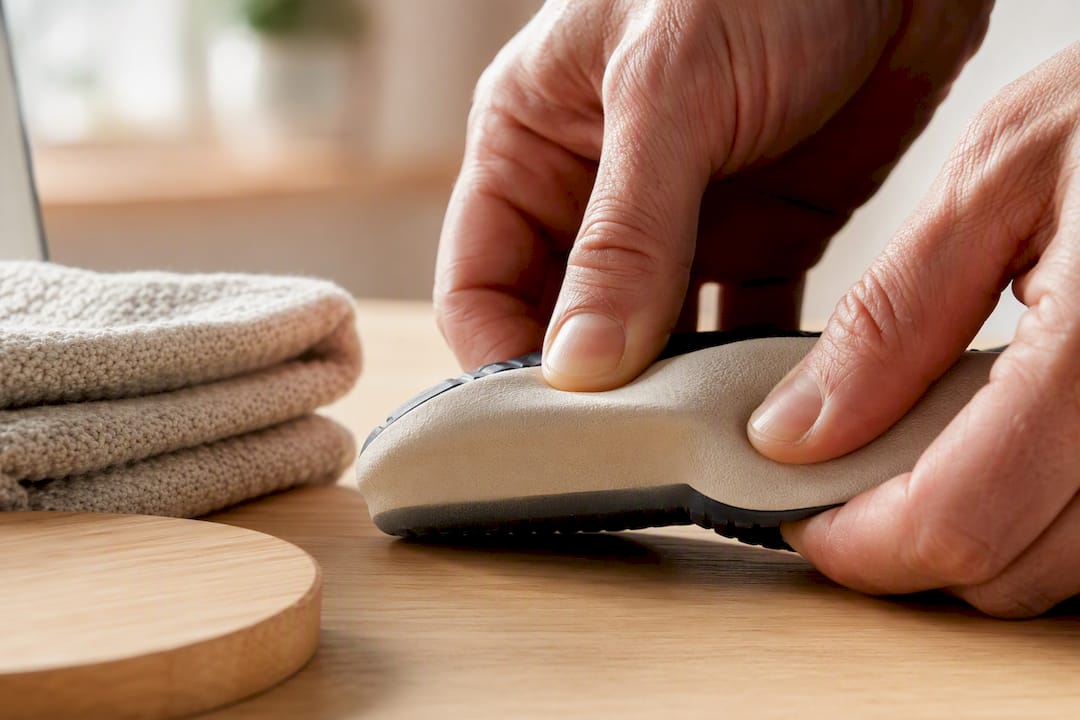
Practical insight: the combination of a foam compression test, torsional twisting, and observing asymmetry in the sole profile is a more reliable indicator of actual wear than simply counting the kilometres walked or run, since wear depends not only on distance but also on the surface, the user's weight, and how often the footwear is worn.
Signs that it is time for new footwear often show up in the body before they appear on the product itself. Foot pain or a sudden change in the way someone walks is often an early signal that the footwear is no longer suitable, even if it still looks reasonably good visually. This is especially important for children, as they rarely point out on their own that something feels tight or that they are walking differently because of inadequate foot support.
Some practical tips for extending the life of footwear:
- Alternate the slippers with another pair, as the material needs time to recover between wears.
- Check the insoles every few weeks, as a worn insole often causes discomfort before the sole itself is actually worn out.
- With children's school footwear, encourage your child to tell you if anything feels tight, as their feet change considerably during the year.
- Replacing laces and insoles can eliminate discomfort without the need for a new pair, making it a cheaper and faster solution.
The author's perspective and how Copa cop handles exchanges
Some retailers treat footwear exchanges as part of building trust, not as an exception you have to go through. Children's slippers need to breathe, fit well, and grow with the child, which is why we have included priority processing in our ordering process for situations where a parent needs a quick solution, for example just before school starts.
What this means for the customer:
- Priority processing of orders, meaning a faster response for exchanges or returns when time is of the essence, such as in the days before the first day of school.
- Free shipping on orders over 50 euros, reducing the cost you would otherwise bear when returning the wrong size.
- A simple exchange process, because you know that a child's foot grows faster than you can predict before purchase.
Slippers should be where your child feels most relaxed: at home on wooden floors, in the playroom, or on the way to school. If the slippers do not fit properly, the path to a solution should be simple, not an additional source of stress for the parent.
If you’re considering a purchase and are worried about choosing the wrong size, take a look at our shoe size conversion guide, which helps narrow down your choice before ordering. Less guesswork about sizing means less need for exchanges later, which is always better for you and your child.
What’s worth knowing before you go to the store
The biggest mistake parents make is checking the exchange rules only when they need them, rather than before purchasing. General terms and conditions are not bureaucratic fine print; they are the only place that states how much time you have and what qualifies as an undamaged product.
Another common misconception is equating an exchange with a warranty claim. A retailer is not obliged to exchange footwear that does not suit your taste or is the wrong color, but is legally obliged to address an actual product defect. This distinction determines whether you will receive understanding or face a refusal in the store.
The most underrated tip in this article is simple: before claiming that footwear is defective, perform a foam compression test. Many suspected defects are merely normal wear and tear that comes with using any slipper.
— Črt
Copa cop makes exchanging footwear simple, not exceptional
Copa-cop is an alternative to buying footwear from retailers where exchanges involve complicated bureaucracy and unclear deadlines. Some retailers offer priority order processing and free shipping above a certain amount, which reduces exchange costs.
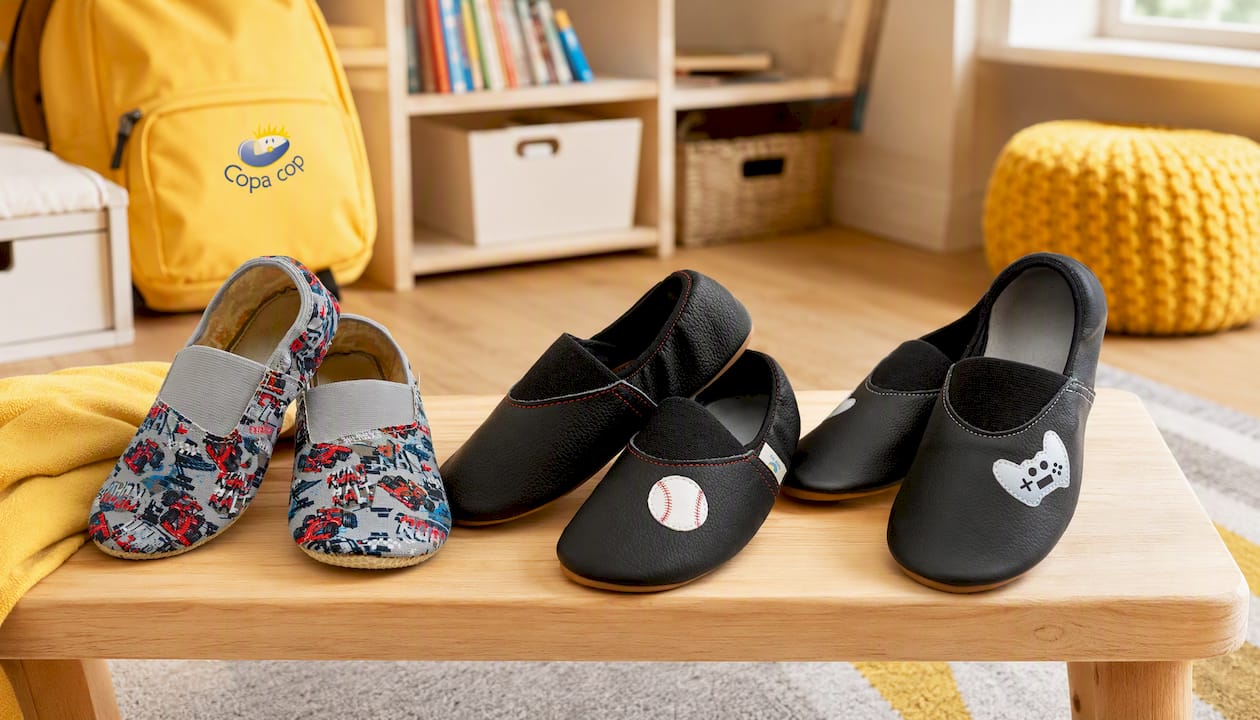
For school and everyday use, we recommend three tried-and-tested models. Formula boys' textile slippers are lightweight and breathable, making them suitable for daily wear at school. Boy's Uni Baseball boys' leather slippers offer a more durable leather upper for children who are more boisterous during play. Boy's Uni Gaming boys' leather slippers are a popular choice among children who like a more modern pattern, while retaining the same ergonomic support for the foot.
If you are unsure about the size or worried that the slipper will already be too small in a month, browse the selection and choose a model that meets your child's needs. Place your order in just a few minutes on Copa-cop, and if you need an exchange, it will be handled without complications.
Sources
The following sources are useful for checking your rights and specific retailer policies:
- EXCHANGE OF GOODS - Men's and a half
- Consumer guarantees (EU guidance)
- Rules for returns and exchanges in Housebrand stores


