

Slippers or socks at home: which is healthier for your feet?
For most homes, the most sensible combination is comfortable slippers for longer walks around the house and non-slip socks for getting up briefly at night. The decision should be based on three things: fit, slip safety, and breathable material. Research on children's foot development does not provide a single rule, so it is wiser to choose based on purpose rather than the fashionable labels “barefoot” or “orthopedic”.
In brief:
- For children, the most important thing is that slippers provide room for the toes and sole flexibility, and that they accommodate the growth of the feet.
- For older adults, it is advisable to choose stable slippers with a firmer, non-slip sole to reduce the risk of falls while moving around the home.
- When choosing footwear for home, it is important to measure both feet in the evening, check toe mobility, and assess your sense of stability while walking.
- Materials such as leather and wool provide durability and breathability, but are usually more expensive than textile models, which are easier to maintain.
- Buying quality slippers on the Slovenian market from manufacturers with clear return and exchange policies enables long-term satisfaction and greater safety.
Table of contents
- Slippers or socks at home: key differences you need to know
- Who should wear slippers and who should stick to socks
- How to choose the right slippers or socks for home
- Safety and healthy movement in indoor footwear
- Slipper and sock maintenance, hygiene, and durability
- Why trust us: the evidence behind the advice
- Average price of slippers and socks for home use
- Where to buy quality slippers and socks for the home
- How long the purchasing process takes from selection to pickup
- Author's perspective: practical advice for families making a choice
- Recommended choice: Copa-cop slippers for every home
- Sources
- Frequently asked questions
Slippers or socks at home: key differences you need to know
Each material has its own role. Slippers protect and keep you warm, while socks breathe and adapt, but only together do they address the question of what to wear at home.
Warmth and comfort. Wool and fur slippers, such as the Sparkly Dots fur house slippers, retain warmth for a long time even on cold floors. Socks alone, however thick, cool the feet more quickly because they lack a sole to separate the skin from the cold surface.
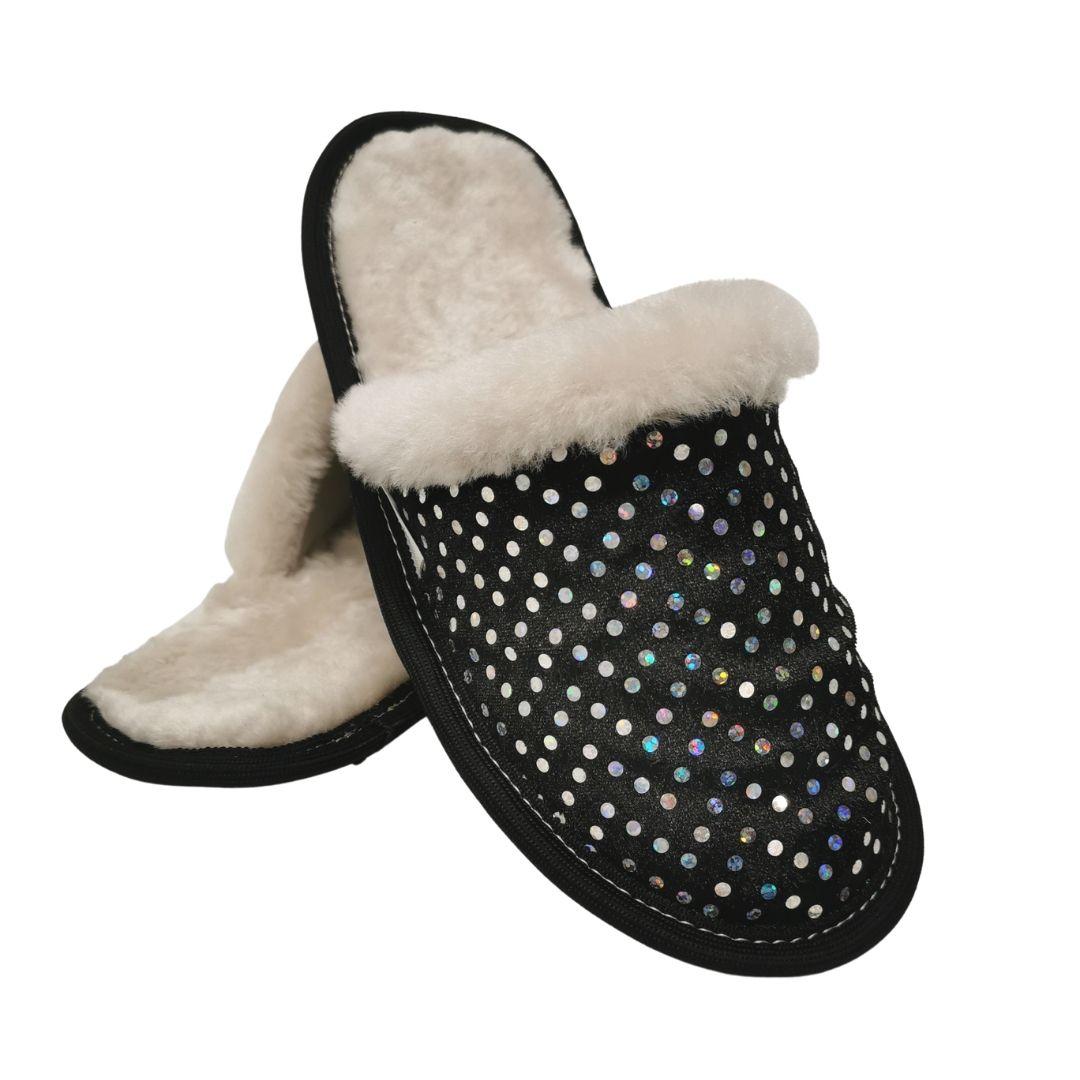
Grip and slip resistance. Slippers with non-slip soles provide a sense of stability when walking on parquet or tiled floors. Regular socks slip on smooth floors, while rubberized strips on the soles significantly reduce this risk, although they remain only a temporary solution, not a permanent replacement for footwear, as shown by the guideline on the use of non-slip socks in hospitals.
Foot support. A rigid sole holds its shape but can limit the natural movement of the toes. A flexible sole follows the movement of the foot with every step.
Hygiene. Textile and cotton slippers can be machine-washed, while leather ones need to be wiped with a damp cloth. Socks should be changed daily, as they absorb sweat more quickly than slippers with a breathable lining.
Brief summary of the differences:
- Warmth: slippers retain heat longer, while socks cool the feet more quickly.
- Safety: non-slip soles on slippers are more reliable than bare socks on smooth floors.
- Flexibility: socks conform better to the shape of the foot, while slippers provide firmer support.
- Maintenance: socks require more frequent washing, while slippers last longer between washes.
Who should wear slippers and who should stick to socks
The choice is not universal. It depends on age, health status, and how much time you spend standing each day.
For children, toe room and sole flexibility are most important, not fashionable appearance. Always measure both feet, as they can differ by as much as half a size in many children, and for rapidly growing feet add approximately a centimeter of extra room, as recommended by the systematic review on footwear for young children. For school days and home, a combination of children's slippers that are lightweight and breathable makes sense.
Older people need stability more than fashion. Slippers with a firmer, non-slip sole and secure fastening are a safer choice for this group than loose slip-ons or socks alone, as unsuitable footwear significantly increases the risk of falls when moving around the home.
People with diabetes, neurological conditions, or other health limitations should choose footwear with a soft but durable sole and consult a pediatrician when making their choice, especially if sensation in the feet is reduced.
Anyone who works from home and stands or walks around the house all day primarily needs cushioning under the arch. A slightly thicker sole that can withstand several hours of daily wear is worthwhile here.
Expert advice: When buying for a child, always try on both slippers with the socks they will actually wear, not with bare feet, because otherwise the size can easily be underestimated during fitting.
- Children: check the toe room and sole flexibility with every step.
- Older adults: choose stable slippers or non-slip socks based on the fall-risk assessment.
- Health limitations: consult a podiatrist before buying more supportive footwear.
- Working from home: put comfort and cushioning under the instep first.
How to choose the right slippers or socks for home
Choosing becomes easy when you follow a clear sequence of steps instead of guessing from the appearance in an online photo.
- Measure both feet in the evening, when the foot is most swollen, and use socks of the same thickness as those you will wear with the slippers.
- Check toe mobility in the selected size; the toes must not touch the tip of the slipper when standing.
- Test for pressure on the instep while walking on a flat surface; a tight sensation means the size is wrong.
- Check stability while walking on stairs or when turning; the sole must not slip, even on parquet flooring.
- Compare materials based on the season and purpose: wool and fur provide warmth, leather is durable, textile is lightweight and washable, and silicone insoles add grip.
Measuring both feet and trying the slippers on with the socks you will actually wear, following the footwear selection guide, significantly reduces the risk of choosing the wrong size, even for house slippers rather than sports shoes. This rule is even more beneficial for young children because their feet change within a few months.
Each material has its own trade-offs and benefits:
| Material | Advantage | Disadvantage |
|---|---|---|
| Wool | Excellent warmth, breathable | Slower drying after washing |
| Leather | Durable, molds to the foot | Requires care, not machine washable |
| Textile | Lightweight, easy to wash | Less warmth in cold months |
| Silicone (insoles) | Additional grip | Not suitable as the sole material on its own |
A 2019 systematic review warns that there is not enough evidence to recommend one type of sole for all young children. Instead, it emphasizes fit, toe room, and flexibility as key measurable features, rather than the product label.
Check this too before buying online:
- Whether a size chart in centimeters is available, not just numerical sizes.
- Whether the store allows size exchanges at no extra cost.
- What the return policy is if the slipper does not fit after delivery.
- Whether the material described is actually natural and breathable.
Safety and healthy movement in indoor footwear
The science of indoor footwear does not offer a single answer, but it does point clearly in one direction. The decision depends on the individual, not on ideology.
An epidemiological multicenter study from 2017 found that children who walk barefoot at home often have a higher foot arch than those who wear footwear. The long-term effects of this difference remain unclear, so the study does not support the claim that one approach is better than the other. Similarly, an analysis of toddlers' gait published in PLOS One shows that footwear affects gait patterns, but provides no basis for a universal rule.
The practical conclusion from the research is simple: when choosing footwear for yourself or your child, it is essential to adapt it to its intended use and individual needs, rather than follow the belief that you should be “always barefoot” or “always shod.”
A few specific measures can help reduce the risk of falls among older people:
- Use slippers with a firmer sole instead of loose slip-ons when getting up at night.
- Non-slip socks should be a short-term solution, not a permanent substitute for footwear.
- Check the sole's grip every few months, because rubber loses its texture over time.
- When getting up at night, always keep your slippers within reach beside the bed.
Socks alone are not a good choice on tiles, stone, or laminate, where the risk of slipping is greatest. Non-slip socks are suitable as a temporary solution, for example after an injury or during recovery, when conventional slippers are unsuitable. People with diabetes or reduced sensation in their feet should consult a doctor before choosing permanent indoor footwear, as a minor injury caused by unsuitable pressure can remain unnoticed for a long time.
Slipper and sock maintenance, hygiene, and durability
A footwear's long service life often depends on proper maintenance rather than the quality of the material itself.
Wool and textile slippers can be washed in the washing machine at a lower temperature, while leather slippers should only be wiped with a damp cloth and air-dried away from the radiator. After each use, place your slippers in a well-ventilated spot for a few hours, as moisture in the lining can quickly become a breeding ground for fungi and unpleasant odors.
The signs that it is time for new slippers are quite obvious:
- The sole is smooth and no longer grips the floor as it did at first.
- The lining is compressed and no longer cushions your foot.
- The seam at the edge has started to tear or come undone.
- The odor remains even after washing or airing out.
When choosing materials for durability, natural fibers such as wool and leather have an advantage over synthetics because they breathe and wear out less quickly from perspiration. Leather slippers are therefore often a better long-term investment than inexpensive synthetic models.
Why trust us: the evidence behind the advice
The recommendations in this article are not made up, but are based on verified sources and many years of slipper-making experience.
The slippers are handmade in Slovenia from natural, breathable materials, enabling breathable linings and easy to put on. Exchanges or returns are available, and shipping is free above a certain amount, making it easier to try the correct size without risk.
Practical recommendations on fit and flexibility are also supported by:
- A systematic review of footwear for young children (2019), emphasizing fit over labels.
- Multicenter study of barefoot and shod children (2017) on differences in foot shape.
- Guide to measuring a child's foot for a specific procedure at home.
For precise measuring and understanding the shape of the toe area, the guide to the shape of the toe area of slippers is also useful, explaining why width at the front is more important than fashionable appearance.
Average price of slippers and socks for home use
The prices of home footwear vary according to the material, not just the brand. Basic textile slippers are generally the most affordable choice, while leather and fur slippers cost more because of the processing and durability of the material.
The price range is smaller for socks. A simple cotton sock is inexpensive, while non-slip socks with a rubberized pattern on the sole cost slightly more because of the additional processing.
When comparing prices, it makes sense to consider the total cost over time, not just the initial price. A leather slipper that lasts for several seasons is often cheaper than three consecutive purchases of a synthetic model that wears out within a year. The same applies to children, whose slippers are used for a shorter time because their feet are growing, so it makes sense to choose a model with an adjustable size or to buy at shorter intervals, but at a more favorable price per item.
Current prices for individual lines, such as barefoot slippers or textile slippers, are published on the Copa-cop website, as they vary depending on the season and material availability.

Where to buy quality slippers and socks for the home
Quality footwear for the home is best purchased from a manufacturer that stands behind its products with a clear returns and exchanges policy, rather than from a random online seller without a verifiable address.
When choosing a store or brand, check three things. First is the origin of the material: natural fibers such as wool, leather, and cotton are more suitable for long-term wear than synthetics. Second is the return policy, since foot size often turns out to differ from expectations only after the first fitting. Third is delivery, where free shipping above a certain amount is often a sign that the store understands the importance of trust when shopping online.
Copa-cop offers school slippers, girls' slippers, and boys' slippers in several colors and patterns, making it easier to choose according to a child's taste, not just function. For adults, house slippers are available in leather and textile versions, depending on whether warmth or product weight is more important.
How long the purchasing process takes from selection to pickup
From selecting the model and size to home delivery, buying domestic footwear online generally takes a few business days, depending on stock and the delivery service's distance.
The process is simple: choose a product and size using the chart, place and pay for the order, and the package then arrives at your address or a pickup location. Priority order processing is available for a one-time fee, allowing the shipment to be handled before the regular queue.
If the size turns out to be incorrect upon delivery, an exchange or return extends the total time until receiving the final, suitable footwear by a few extra days. It therefore makes sense to include an accurate foot measurement in centimeters with the order right away, rather than just the selected size, as this reduces the likelihood that the product will need to be exchanged.
Author's perspective: practical advice for families making a choice
Always choose a children's model to accommodate a rapidly growing foot, while selecting an adult model according to its purpose - warm for winter, lightweight for summer. The option of hassle-free exchanges is actually more important than the price itself when buying footwear online, because the right size is often unclear until the foot is inside the slipper. At home, I recommend a combination of comfortable slippers for longer walks and non-slip socks for short trips between rooms.
— Črt
Recommended choice: Copa-cop slippers for every home
Copa-cop is an alternative to random online providers without a verifiable return policy, as it offers handmade slippers from Slovenia with a clear exchange option if the size is not right.
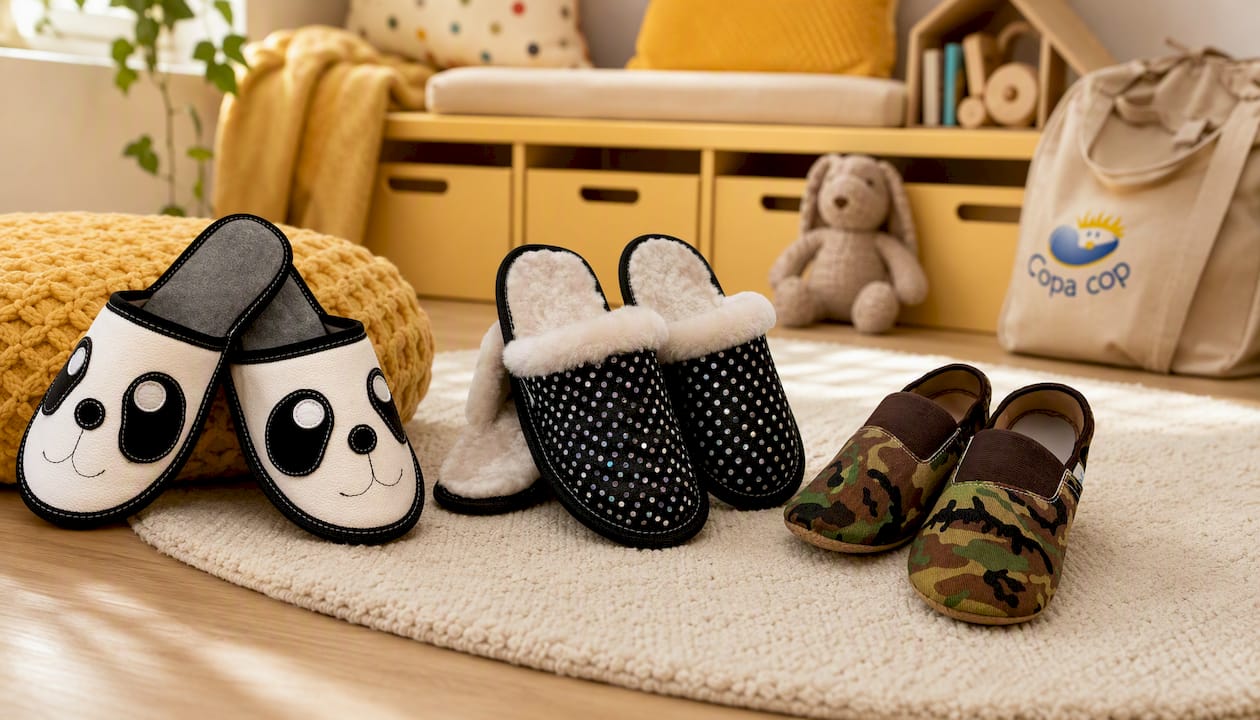
For adults looking for a warm and durable solution, the Panda leather house slippers are made from natural leather that gradually molds to the foot. Those who prioritize softness and warmth during the coldest months will find a pleasant alternative to classic slippers in the Sparkly Dots fur house slippers. For boys who need lightweight footwear for home and school, the Camo boys’ textile slippers are washable and flexible enough for everyday use.
Before ordering, measure both feet in the evening, check the size chart, and remember that an exchange is possible if the fit is not perfect upon receipt.
Sources
The recommendations support a systematic review on children’s footwear and the foot measurement guide.
- Footwear for young children: a systematic review (2019)
- Effects of footwear on children’s gait (PLOS One)
- Habitually barefoot vs shod children’s foot morphology (2017)
Frequently asked questions
Is it better to walk barefoot, in slippers, or in socks at home?
There is no single correct answer, as research on toddlers’ walking does not support a universal rule. For safety and warmth, the best combination is comfortable slippers and non-slip socks depending on the occasion.
What kind of slippers should I choose for a child at home?
Choose slippers with enough room for the toes and a flexible sole, not rigid models. A 2019 systematic review advises that fit should be more important than the label “orthopedic” or “barefoot.”
Are non-slip socks safe enough for older people?
Non-slip socks are suitable as a short-term solution, for example at night, but not as a permanent replacement for footwear. For long-term use, slippers with a firm, non-slip sole are safer, as shown by the guideline on falls among older people.
How much do quality house slippers cost?
The price depends on the material; leather and fur models are generally more expensive than textile ones because of their durability. The current prices of individual Copa-cop lines, such as house slippers, are published on the website.
How do I correctly measure a child’s foot when buying slippers?
Measure both feet in the evening, when the foot is most swollen, and add approximately one centimeter of room for growth. You can find the detailed procedure in the guide to measuring a three-year-old’s size.


